The Search Landscape Has Splintered, And Your Clients Are Losing Visibility
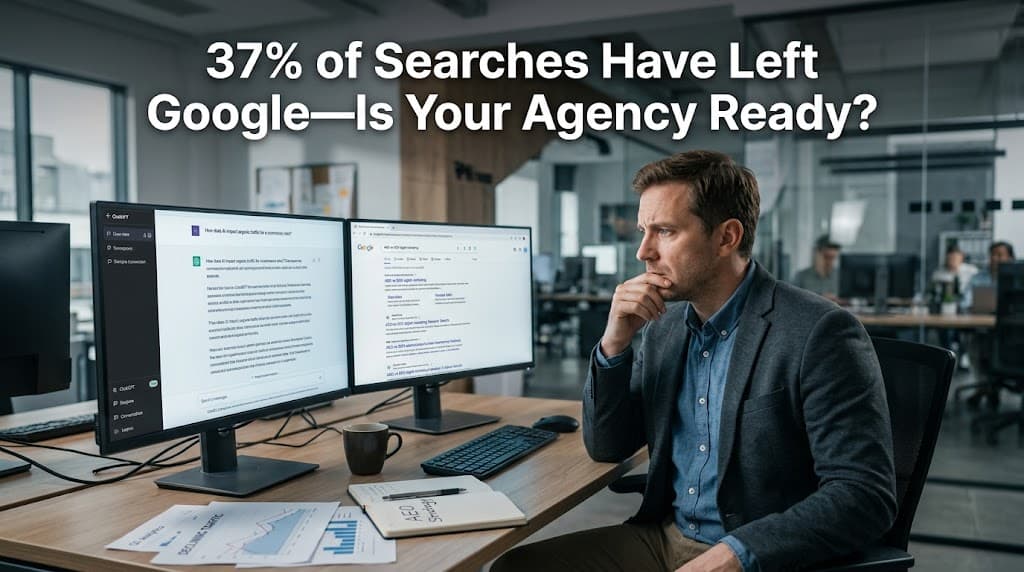
The numbers tell a stark story that most agencies are still ignoring: 37% of searches now start on AI platforms, not Google. ChatGPT alone has reached 700 million weekly active users, while Perplexity has grown 50-66% year-over-year. Google has embedded AI Overviews into 30-50% of queries, and AI tools already handle 15% of all searches. Your clients' buying decisions are happening in spaces where traditional SEO strategies simply don't reach.
The search landscape has fragmented across multiple AI platforms. Users are asking detailed questions on ChatGPT, researching products through Perplexity, comparing options on Claude, and getting quick answers through Gemini. Meanwhile, most agencies are still optimizing for a single search engine using tactics designed for 2019. The result is predictable: declining organic traffic, reduced lead generation, and clients questioning the value of their SEO investment.
This isn't a temporary shift or a fad that will fade. AI search represents a fundamental change in how people find information and make purchasing decisions. Agencies that continue to rely solely on traditional SEO will watch their clients lose market share to competitors who understand where the conversation is actually happening.
Why Traditional Keyword Strategy Fails in an AI-Powered Search World
The foundation of traditional SEO has crumbled. AI search prompts are 4-6x longer than traditional keywords, completely changing how content needs to be structured and optimized. Where users once typed "best dentist near me," they now ask AI platforms detailed questions like "What should I look for when choosing a family dentist for my kids who are nervous about dental visits, and what questions should I ask during the consultation?"
The old approach of stuffing 15 exact keywords into 500 words no longer works for ranking. AI systems prioritize semantic understanding and conversational intent over keyword density. They evaluate brand credibility through third-party mentions, reviews, testimonials, and publisher citations rather than counting how many times you mentioned your target phrase. Google's AI Overviews and other AI search platforms use context and user intent to determine relevance, making exact-match tactics obsolete.
This shift demands a complete rethinking of content strategy. Instead of targeting short, high-volume keywords, successful agencies now optimize for the longer, more specific queries that AI users actually ask. The content that ranks in AI search results answers complete questions, provides comprehensive information, and demonstrates expertise through depth rather than keyword repetition.
The Core Problem: Users Get Answers Without Visiting Websites
The most challenging aspect of AI search isn't just the change in query length or ranking factors. The real issue is that users increasingly get complete answers without ever visiting your clients' websites. AI platforms provide direct responses to questions, summarizing information from multiple sources and presenting it in a conversational format that eliminates the need to click through to individual sites.
This fundamentally changes the ROI conversation with clients. Traditional metrics like organic traffic and click-through rates become less meaningful when potential customers are making decisions based on AI-generated summaries. Your clients' expertise and services might be perfectly represented in these AI responses, but they're not getting credit, leads, or conversions from that visibility.
The new reality requires agencies to think beyond website visits and traditional conversion funnels. Visibility in AI summaries and responses is now as important as ranking in Google's organic results. Clients need to be positioned as the authoritative source that AI platforms reference when answering questions in their industry, even if that doesn't immediately translate to direct website traffic.
Answer Engine Optimization (AEO): The Framework Your Agency Needs
Answer engine optimization represents the evolution of SEO for an AI-powered search environment. Unlike traditional SEO, which focused on ranking for specific keywords, AEO ensures your clients' expertise and content are referenced by AI platforms when users ask relevant questions. This requires a completely different approach to content creation, brand building, and technical optimization.
The framework rests on three essential pillars. First, semantic authority and brand credibility signals become paramount. AI platforms evaluate businesses based on third-party mentions, customer reviews, industry testimonials, and citations from reputable publishers. Your clients need to be recognized as legitimate experts in their field through external validation, not just their own marketing claims.
Second, conversational content structure replaces keyword-focused writing. This means developing comprehensive FAQ sections, detailed how-to guides, scenario-based explanations, and comparison content that directly answers the longer, more specific questions AI users ask. The content should read naturally and provide complete answers rather than forcing users to piece together information from multiple sources.
Third, structured data and semantic markup help AI systems understand and categorize your clients' content. FAQ schema, How-To schema, and entity tagging make it easier for AI platforms to extract relevant information and include it in their responses. This technical foundation ensures that well-crafted content actually reaches AI platforms in a format they can process and reference effectively.
Three Practical AEO Strategies for Your Client Portfolio
The transition to answer engine optimization doesn't require completely rebuilding your clients' digital presence, but it does demand strategic adjustments to current practices. Start by rebuilding FAQ and how-to content to address the 4-6x longer conversational queries that AI users actually ask. Instead of brief answers targeting short keywords, create comprehensive responses that anticipate follow-up questions and provide complete solutions.
Focus on building brand authority through systematic third-party citation development. This means actively pursuing mentions in industry publications, encouraging detailed customer reviews across multiple platforms, and developing relationships with other businesses that can provide testimonials and referrals. AI platforms heavily weight these external credibility signals when determining which sources to reference in their responses.
Implement AI-optimized structured data across all client websites. This includes FAQ schema for question-and-answer content, How-To schema for instructional guides, and proper entity markup for business information. The technical implementation makes your content more accessible to AI platforms while also improving performance in traditional search results.
eezyRank's AI-powered automation capabilities make it possible to scale these strategies across multiple clients without proportional increases in manual work. The platform can generate AEO-optimized content, implement proper structured data, and track performance across both traditional and AI search platforms, allowing agencies to deliver advanced optimization services efficiently.
Scaling AEO Across Your Client Base: Automation is Non-Negotiable
Managing answer engine optimization strategies across multiple clients manually creates an impossible workload. Each client needs industry-specific content that addresses their unique customer questions, proper technical implementation, and ongoing optimization based on AI platform performance. Traditional agencies attempting this manually either deliver subpar results or become unprofitable due to the time investment required.
AI-powered automation solves this scalability challenge by generating customized AEO content for each client while maintaining quality and relevance. Platforms like eezyRank can create FAQ sections, how-to guides, and comparison content tailored to specific industries and local markets. The automation handles technical implementation of structured data while providing performance tracking across multiple AI platforms and traditional search engines.
This efficiency advantage becomes a competitive differentiator for agencies. You can offer comprehensive AEO services to existing clients while taking on new accounts without proportional team growth. Clients see improved visibility in AI search results, better lead quality from longer-form queries, and stronger brand authority signals. Meanwhile, your agency maintains profitability while delivering cutting-edge optimization that most competitors cannot match.
The agencies that implement automated AEO strategies now will have a significant advantage over those still trying to scale traditional SEO manually. As AI search continues to grow and fragment across platforms, this efficiency gap will only widen.
The 2026 Agency Imperative: Adapt Now or Lose Market Position
The search landscape has permanently changed, and the agencies that adapt to AI-powered search will thrive while others struggle with declining results and client churn. Answer engine optimization isn't an add-on service or a nice-to-have strategy. AEO serves as the foundation of effective digital marketing in 2026 and beyond.
Your clients' competitors are already implementing AEO strategies, building authority in AI search results, and capturing leads from the 37% of searches that now start on AI platforms. Every month you delay adoption puts your clients further behind in the spaces where their customers are actually making decisions. The agencies that move quickly will retain existing clients and win new ones based on demonstrable results in AI search visibility.
The transition requires immediate action across three areas: audit your current client content for AEO readiness, rebuild FAQ and how-to content for conversational queries, and implement AI-optimized structured data and automation systems. This isn't about abandoning traditional SEO entirely, but rather expanding your capabilities to cover the full spectrum of where modern search happens.
Start by evaluating your top five clients' current content against AEO best practices. Identify gaps in conversational content, assess their third-party authority signals, and prioritize the most impactful improvements. Then implement eezyRank's AI-powered automation to scale these improvements efficiently across your entire client portfolio. The agencies that take action today will dominate the AI search landscape while their competitors struggle to catch up.


